Lumcloon of the Flatterys
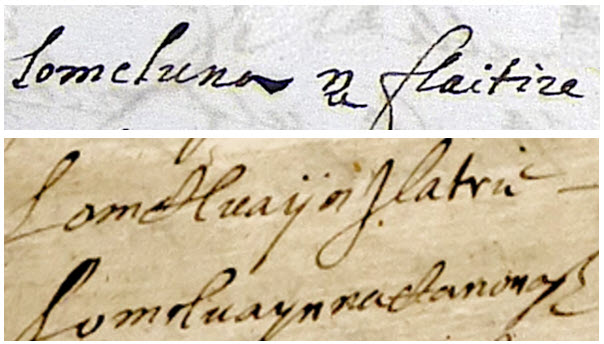
Lomcluna na Flaitire
CONTENTS
1. Banagher LUMCLOON OF THE FLATTERYS and the Plantation of West Offaly.
2 Ath Croich – THE OLDE ENGlish Towne – Banagher Name
3 The Maps – LOMCLUNA NA FLAITIRE – A WEST OFFALY HISTORY
STUDY CONTENTS
ACKNOWLEDGEMENTS
INTRODUCTION
A NOTE ON SOURCES
PART 1: LUMCLOON OF THE FLATTERYS
- WHERE IS LUMCLOON
- LOMCLUNA NA FLATIRE
- BATTLES IN LOMCLUNA: 1285 & 1444
- PARDONS FOR THE FLATTERYS 1602
PART 2: SIR MATTHERW DE RENSI AND LOMCLUNA
- SIR MATHEW DE RENSI (1577-1634)
- SIR MATTHEW DE RENSI LINGUIST AND MAN OF LETTERS
- MAPPING LOMCLUNA
- BANAGHER CORPORATION LANDS IN LOMCLUNA 1628
- SIR ARTHUR BLUNDELL IN BANAGHER
PART 3: PLANTATION OF WEST OFFALY 1619-1620
- PLANTATION SURVEYORS IN WEST OFFALY LOMCLUNA THE BIGGEST AND THE GREATEST PLOUGHLAND
- LOMCLUNA THE BIGGEST AND THE GREATEST PLOUGHLAND
- BANAGHER TO CLONONY 400 YEARS AGO
- THE CASTLE AND SEAT OF LISCLUNA LISCLOONEY
- LOCATING LOMCLUNA
- SHADES OF MACHIAVELLI IN BANAGHER c.1625
PART 4: GUNPOWDER AND WARFARE IN LOMCLUNA
- OWEN ROE O’NEILL (c.1580-1649)
- FORT FALKLAND IN THE WARS OF THE 1641 REBELLION
- MAKING GUNPOWDER IN LOMCLUNA
- BLUNDELLSBURY : ARTHUR BLUNDELL’S HOUSE IN LOMCLUNA
- LOMCLUNA IN THE CROMWELLIAN WARS
ART 5: THE SURVIVAL OF THE FLATTERYS
- THE FLATTERYS AFTER THE 1660s
- THE FLATTERYS AND THE CLEMENT CONNECTION
- THE EIGHTEENTH AND NINETEENTH CENTURIES
CONCLUSION

ACKNOWLEDGEMENTS
ACKNOWLEDGEMENTS
Without the scholarly research by Brian Mac Cuarta SJ on the extraordinary career of Sir Matthew De Renzy in Ireland this study would not have been possible. The list of his writings below underlines the depth and extent of his knowledge of this subject. While historians at large are greatly indebted to him students of the plantations in the early seventeenth century midlands that derive most benefit from his work. This is particularly so at this time when the 400th anniversary of this era is remembered.
We are greatly indebted to Conchubhar Ó Crualaoich of Logainm.ie for his learned opinions on the etymology and genealogy of Lomchluain Uí Fhlaitire and other local placenames. Our thanks also to The National Archives in London where the De Rensi Manuscripts have been housed since the 1850s.
References
‘Newcomers in the Irish midlands 1540-1641’, (MA thesis, NUIG 1980)
‘Matthew De Renzy’s letters on Irish Affairs 1613-1620’, Analecta Hibernica, 34 (1987)
‘A planters funeral, legacies and inventory: Sir Matthew De Renzy 1577-1634’, JRSAI, 127 (1997)
‘A settler’s land disputes in a Gaelic lordship: Matthew De Renzy in Delvin MacCoghlan’, 1613-18′, Studia Hibernica, 30 (1998-9).
‘Conchubhar MacBruaideadha and Sir Matthew De Renzy (1577-1634)’, Éigse, 27(1993)
Sir Matthew De Renzy, Dictionary of Irish Biography 2009
‘Sword’ and ‘word’ in the 1610s: Matthew De Renzy and Irish reform (2011), in Reshaping Ireland 1550-1700, (ed). Brian Mac Cuarta
‘A Planters Interaction with Gaelic culture’: Sir Matthew De Renzy (1577-1634)’, Irish Economic and Social History, 20 (1993).
‘Sir John Moore’s inventory, Croghan, King’s County, 1636′, Journal of the County Kildare Archaeological Society, 19 (2000-1)
The Irish Revenues of Oliver St John’, Analecta Hibernica, 45 (2014)
ACKNOWLEDGEMENTS
The images reproduced here are done so with their permission. The staff of Offaly History and Offaly Heritage office have been most supportive. The courtesy and co-operation of the directors and staff of the National Library of Ireland, the National Archives of Ireland, the British Library and the National Archives in Kew are also much appreciated.
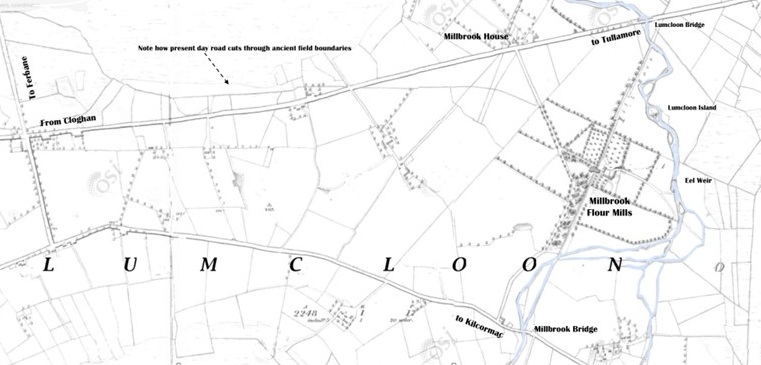
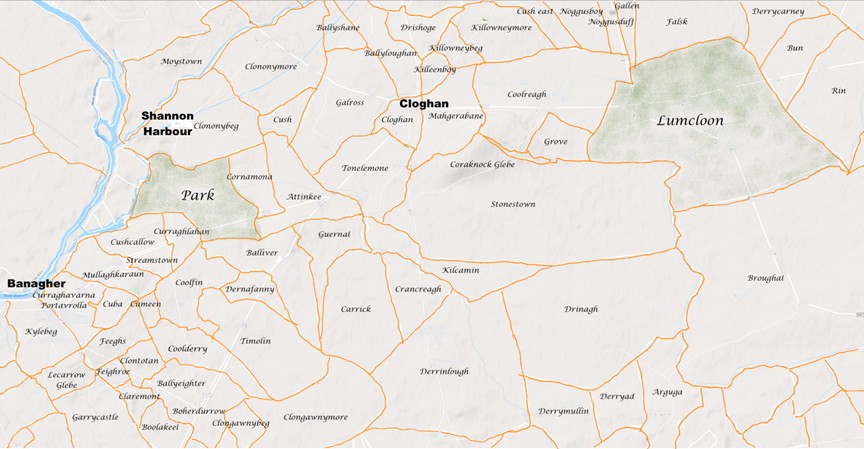
This map shows the ancient townlands of part of West Offaly in their present day configuration. Townland names are mostly of Gaelic origin and relate to a topographical feature . The size and shape of townlands was decided by the Ordnance Survey in the 1830s in consultation with local landowners, clergymen and antiquarians. The townlands of Park and Lumcloon which are central to this study are shaded.
INTRODUCTION
INTRODUCTION
This presentation establishes the existence of two places in West Offaly known as Lumcloon. One of these which lies a few miles east of Cloghan is familiar and is the modern townland of that name. The other Lumcloon as in Lomcluna na Flaitire, which included several townlands between Banagher and Cloghan, has a rich and well documented history that has been lost in time.
The Irish version Lomcluna na Flaitire is used throughout this essay as it appears in the De Rensi manuscripts. Another version Lomchluain Ui Fhlaitile also appears in sources. Doctor Conchabhar Ó Cruaolich placenames officer elaborates on this variation as follow: Lomchluain is attested as Lomchluain Uí Fhlaitile in standard Modern Irish in the middle of the 16th century. It has been anglicised as Flattery, due to dissimilation of the second /l/ to /r/ under influence of the first /l/, and that name is still found in the area. Indeed, early anglicised examples of Ó Flaitile such as ‘O’Fflatrye’ (see logainm.ie) suggest that this had occurred in the Irish form of the name. Dissimilation occurs relatively frequently in Irish, English and other languages.
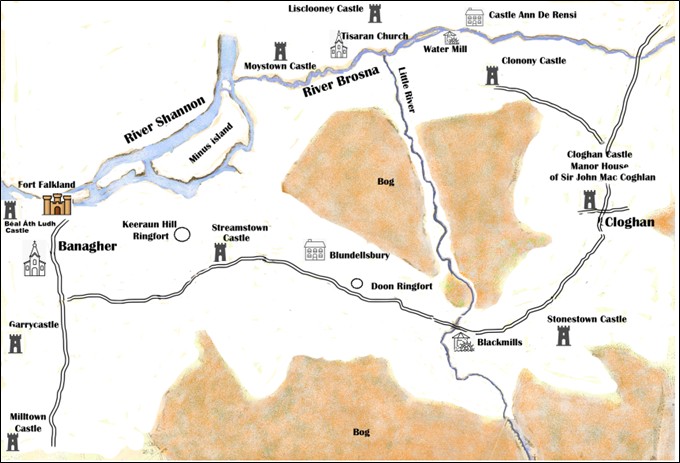
The transfer of the ownership of local lands is central to this study. Therefore the names of townlands recur throughout. Most of these of these are in current usage while others have become obsolete or indeed extinct. It would be useful for readers to familiarise themselves with the layout of the townlands in West Offaly. A map locating these townlands and outlining their shape and size is reproduced on the opposite page
SOURCES
